
How to Prepare a CNC Machining RFQ: Complete Buyer Checklist
A complete CNC machining RFQ helps suppliers understand what must be manufactured, controlled, inspected, and delivered. Clear technical information reduces clarification rounds, prevents assumptions, and allows buyers to compare quotations on the same scope instead of comparing prices built on different requirements.
A complete CNC machining RFQ should include current 3D CAD data, a controlled 2D drawing, part number and revision, units, material and grade, quantity, critical tolerances, GD&T, finishing, inspection requirements, documentation needs, and target delivery. Clear scope helps suppliers review manufacturability, select an appropriate machining route, and prepare quotations based on consistent technical assumptions.
A good RFQ is therefore not simply a request for a price. It is a controlled package of engineering and purchasing information.

What Is a CNC Machining RFQ?
RFQ stands for Request for Quotation.
In CNC machining, an RFQ is the package of technical and commercial information a buyer sends to a supplier so the supplier can evaluate the part and prepare a quotation.
The RFQ should answer the questions that directly affect manufacturing scope. These typically include:
- What part is being quoted?
- Which revision is current?
- What material is required?
- How many parts are needed?
- Which tolerances and GD&T requirements matter?
- What surface finish or secondary processes are required?
- What inspection or documentation is required?
- When and where are the parts needed?
An RFQ is not the same as a purchase order. The RFQ requests pricing and manufacturing terms. A purchase order normally comes later, once technical scope, commercial terms, and supplier selection have been confirmed.
The more complete the RFQ, the easier it is for both sides to identify assumptions before production begins.
What Information Should a CNC Machining RFQ Include?
A useful CNC machining RFQ should give the supplier enough information to understand geometry, controlled requirements, quality scope, production quantity, and delivery expectations.
A practical checklist is:
| RFQ Item | What to Provide | Why It Matters |
|---|---|---|
| Part identification | Part number, name, revision | File and order control |
| Units | mm or inch | Prevents interpretation errors |
| 3D CAD | Current model (e.g. STEP, IGES) | Geometry and DFM review |
| 2D drawing | Controlled revision | Tolerances, GD&T, notes |
| Material | Alloy, grade, condition where relevant | Material and process planning |
| Quantity | Current order and repeat intent if known | Setup and production strategy |
| Tolerances | Critical features and general requirements | Process control |
| Surface requirements | Roughness, finish, secondary processing | Manufacturing scope |
| Inspection | Critical features and reports if required | Quality scope |
| Documentation | Specific records if required | Quote scope |
| Delivery | Required date and destination | Production planning |
| Packaging / shipping | Special requirements if applicable | Commercial scope |
Not every project needs every possible requirement. A simple prototype may need only basic dimensional inspection and standard packaging. A more controlled production part may require additional reporting, traceability, or customer-specific documentation.
The RFQ should communicate what the project actually needs.
Should You Send a 3D CAD Model, 2D Drawing, or Both?
For many CNC projects, sending both is the clearest approach. A 3D model and a 2D drawing serve related but different purposes.
3D CAD Model
A 3D CAD model primarily defines the nominal part geometry. It allows the supplier to review:
- Overall shape
- Pockets
- Holes
- Profiles
- Surfaces
- Feature access
- Machining orientation
- DFM risks
A neutral format such as STEP is commonly used for CNC quotation, although suppliers may support other CAD formats. The important point is that the file should represent the current design revision.
Controlled 2D Drawing
A controlled 2D drawing typically communicates the engineering requirements that cannot be understood from geometry alone. These may include:
- Critical dimensions
- Dimensional tolerances
- GD&T
- Datums
- Threads
- Surface roughness
- Material notes
- Heat-treatment or finishing notes
- Inspection requirements
- General tolerance notes
- Drawing revision
A useful way to think about the difference is: The model defines the shape; the drawing defines the controlled requirements.
A 3D model alone may be sufficient for some simple quoting situations, but it can become ambiguous when tight tolerances, GD&T, threads, finishes, or inspection requirements matter. For controlled engineering work, the supplier should not have to guess which dimensions are critical.

Why Do Part Number, Units, and Revision Control Matter?
File control is one of the simplest ways to reduce RFQ mistakes. Three details are especially important: part number, units, and revision.
Part Number
A clear part number helps align the RFQ, drawing, quotation, purchase order, inspection records, and future repeat orders. Part names alone can be ambiguous. A unique part number gives both buyer and supplier a consistent reference.
Units
The RFQ should make clear whether dimensions are in millimeters (mm) or inches. A unit mismatch can affect dimensions, tolerance interpretation, and quotation. Units should not depend on assumption.
Drawing and Model Revision
The 3D model and controlled drawing should represent the same engineering revision. For example, problems can occur when:
- The PDF drawing is Rev C but the STEP file is Rev B
- A tolerance changes in the drawing but the model is not updated
- A finishing requirement changes but an older RFQ package is reused
- The purchase order references a different revision from the quotation
When possible, use consistent file names and revision identifiers. If the 3D model and controlled drawing contain conflicting information, the RFQ should identify which document governs or request clarification before quotation. The supplier should not be expected to decide silently which file is correct.
How Should You Specify Material?
Material should be specified as clearly as the project requires.
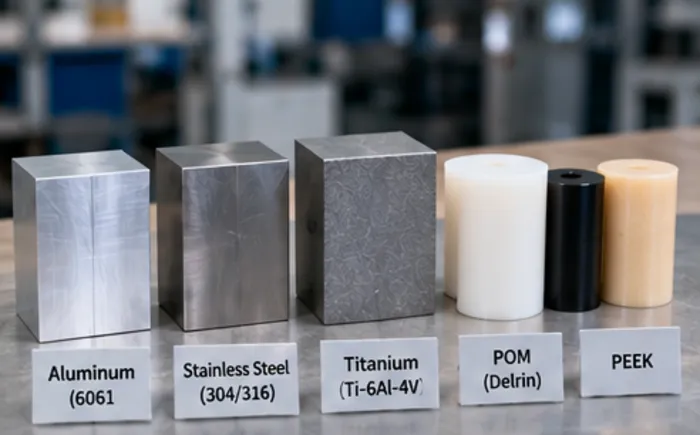
Writing only “Aluminum” may not provide enough information. Where applicable, include:
- Material family
- Alloy or grade
- Temper or condition
- Customer-approved alternatives, if any
- Certification or traceability requirements, if required
Examples of material families relevant to CNC machining include Aluminum (6061-T6, 7075), Stainless steel (304, 316L), Titanium, POM, and PEEK (engineering thermoplastics, not metals).
Material choice affects more than raw-stock price. It can also affect cutting strategy, tool wear, heat generation, workholding, dimensional stability, surface condition, and inspection.
If material certification, traceability, or a specific documentation format is required, state that during the RFQ stage rather than assuming it is included. Likewise, if equivalent material substitutions are permitted, define that clearly.
How Should You Specify Quantity and Production Intent?
Quantity affects setup strategy, tooling, workholding, cycle-time planning, and unit cost. At minimum, state the quantity being quoted. If relevant, you may also provide:
- Prototype quantity
- Initial order quantity
- Expected repeat quantity
- Estimated annual usage (EAU), if meaningful
This information can help the supplier decide whether a simple prototype setup is appropriate or whether more repeatable workholding and production planning should be considered. For example, one prototype and 2,000 recurring pieces may justify different manufacturing strategies even if the geometry is identical.
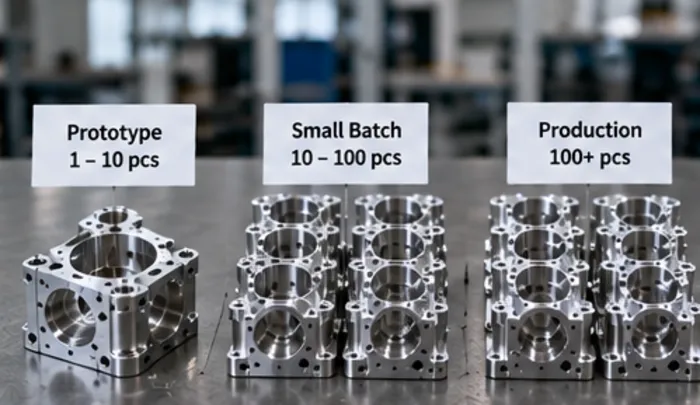
Future production information does not need to be exact if it is not yet known. It should be provided only when it is useful and realistic. The important point is to avoid asking the supplier to quote production strategy without knowing whether the requirement is one piece or recurring demand.
For recurring programs, see our high-volume CNC machining capabilities.
How Should You Communicate Tolerances and GD&T?
Tolerance requirements should be communicated on the controlled engineering drawing when they affect part acceptance. Do not rely on a separate email to communicate critical tolerances that should be part of the controlled specification. A supplier may need to understand:
- General dimensional tolerances
- Individually specified critical tolerances
- Fits
- GD&T
- Datum references
- Critical feature relationships
- Inspection expectations
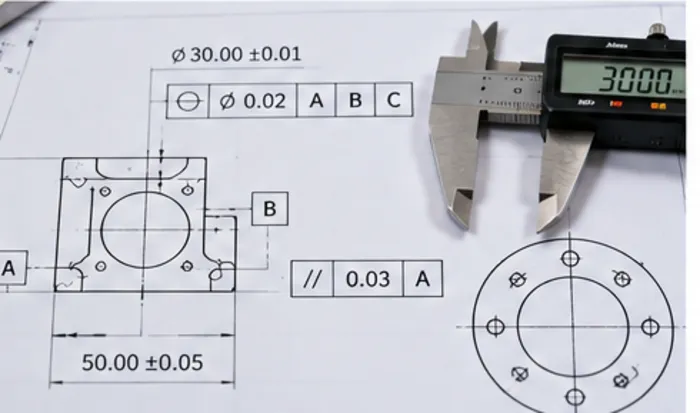
Not every dimension needs a tight tolerance. Tighter requirements may affect machining strategy, setup stability, finishing operations, inspection effort, and cost.
For suitable features and projects, YCS can support tolerances as tight as ±0.005 mm, depending on part geometry, material, machining process, machine capability and condition, thermal stability, and inspection requirements. This is not a default tolerance for every dimension.
If a requirement is critical to fit, sealing, motion, location, alignment, or another function, communicate it clearly on the drawing. For more detail, see our CNC Machining Tolerances Guide.
How Should You Specify Surface Finish and Secondary Processing?
Surface requirements can affect both the manufacturing route and quotation scope. The RFQ should distinguish between:
Machined Surface Requirements
These may include specific surface roughness (e.g. Ra 1.6 μm, Ra 0.8 μm) or functional surface conditions.
Secondary Finishing
Depending on the project, secondary processes may include anodizing, plating, passivation, blasting, polishing, or other specified treatments.
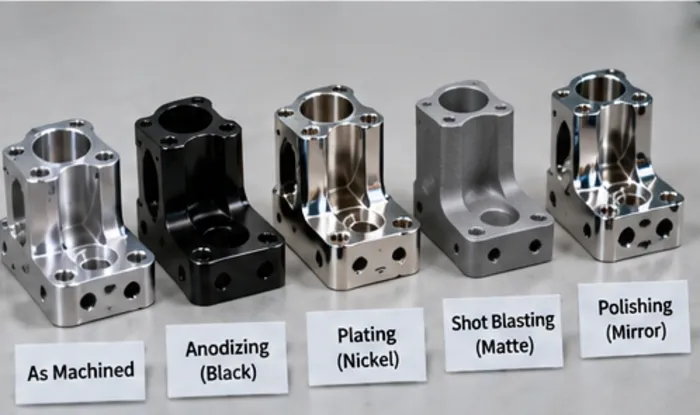
These processes can affect dimensions, cosmetic appearance, handling, masking, inspection, and lead time.
For critical features, the drawing should clarify whether the specified tolerance applies:
- Before finishing
- After finishing
- Or to a masked or protected feature
If a hole, bore, thread, sealing surface, or electrical contact area must remain controlled after finishing, state that clearly. Finishing should be part of the RFQ scope, not added as an undocumented assumption after the machining quote is prepared.
What Inspection and Documentation Requirements Should Be Included?
Inspection requirements affect manufacturing planning and quotation scope. The RFQ should define only the level of inspection and documentation the project actually requires.
Possible requirements may include, where applicable:
- Basic dimensional inspection
- Critical feature inspection
- Dimensional report
- CMM inspection
- First Article Inspection (FAI)
- Customer-specific inspection format
- Material documentation / Mill Test Certificates (MTC)
- Traceability records
- Special quality documentation

Not every CNC project needs all of these. A simple prototype may require only verification of key dimensions, whereas a more controlled production part may require detailed records. The important point is to communicate these requirements before quotation.
Adding a full dimensional report, CMM program, or special documentation after price has already been agreed can change the scope significantly. The drawing should also identify which features are genuinely critical to help the supplier plan an inspection method appropriate to the actual engineering risk.
Learn more about our quality and inspection approach.
How Should You Specify Delivery and Commercial Scope?
A requested delivery date by itself may not fully define the delivery requirement. Where relevant, include:
- Requested delivery date
- Delivery destination
- Required quantity by date
- Partial-delivery requirements, if applicable
- Special packaging requirements
- Shipping or Incoterm requirement, where applicable
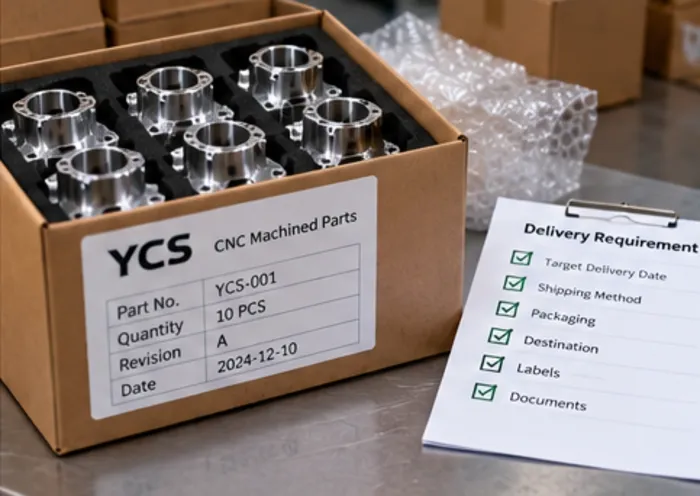
For international sourcing, commercial boundaries should be clear enough for quotations to be compared meaningfully. One supplier may quote only the manufactured parts, while another may include different packaging or transportation assumptions. If those differences matter to the purchasing decision, define the scope before comparing prices.
The RFQ does not need to become a logistics manual. It simply needs to make commercially important assumptions visible.
What Should Never Be Left to Assumption?
A useful rule for CNC machining RFQs is: If a requirement affects part acceptance, manufacturing route, or price, it should not depend on an undocumented assumption.
Critical items to confirm include:
- Material grade & condition
- Units (mm vs inch)
- Drawing and CAD revision
- Critical tolerances & general tolerance standard
- Surface finish & secondary processing
- Inspection scope & documentation
- Quantity & repeat production intent
- Delivery destination & packaging requirements
Some assumptions are unavoidable during early quoting. When that happens, they should be documented and confirmed rather than silently interpreted. Clear assumptions make later quote comparison and purchase-order review much easier.
What Are Common CNC Machining RFQ Mistakes?
Many quotation delays come from incomplete or conflicting information rather than difficult geometry. Common mistakes include:
- Sending Only a Screenshot or Image: An image may help communicate appearance, but it is not a substitute for controlled CAD and drawing information when accurate geometry matters.
- Sending Only a 3D Model When Controlled Requirements Matter: The model may define geometry but not communicate tolerances, GD&T, surface requirements, or inspection expectations.
- Missing Material Grade: “Aluminum” or “plastic” may not provide enough information to select material or quote consistently.
- Missing Units: Do not assume that the supplier will correctly infer mm or inch.
- No Quantity: Quantity directly affects setup allocation and production planning.
- CAD and Drawing Revision Mismatch: If model and drawing revisions differ, the supplier may not know which design is current.
- Unclear Tolerance or Datum Requirements: Critical requirements should be controlled on the drawing rather than left to informal communication.
- Finish Not Clearly Specified: Terms such as “anodized” or “polished” may still need further project-specific clarification.
- Inspection Added Only After Quotation: Inspection and documentation can affect price and lead time.
- Comparing Quotes With Different Scope: A lower quote may exclude operations another supplier included.
Incomplete RFQs do not automatically mean a higher price, but they create assumptions, clarification rounds, and quotations that may be based on different technical scopes.
How Does a Complete RFQ Improve Quote Accuracy and Comparability?
A complete RFQ does not guarantee the lowest price. Its main value is reducing uncertainty.
When the supplier knows the geometry, material, quantity, tolerances, inspection, finishing, and delivery scope, it can evaluate the actual manufacturing route. This improves manufacturability review, process selection, setup planning, inspection planning, cost estimation, lead-time planning, and quote comparability.
Consider two suppliers quoting the same part:
- Supplier A includes: Correct material grade, secondary finish, critical-feature inspection, and dimensional documentation.
- Supplier B assumes: A different material condition, no finish, and basic inspection only.
The numbers may look comparable, but the technical scopes are not. For buyers, the goal is to compare equivalent quotations. For more detail on cost structure and quote comparison, see our CNC Machining Cost Guide.
CNC Machining RFQ Checklist
Before sending an RFQ, confirm the following items:
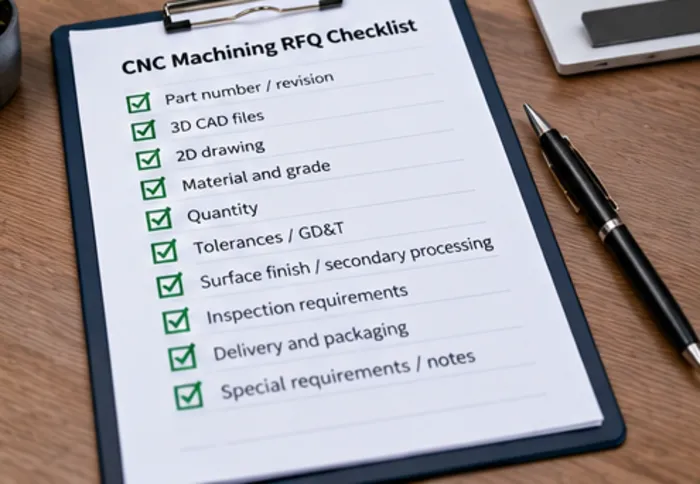
- Part number is included
- Part name is clear
- Drawing revision is current
- Units are defined (mm / inch)
- 3D CAD model is current
- Controlled 2D drawing is included where required
- Model and drawing revisions match
- Governing document is clear if files conflict
- Material and grade are defined
- Material condition is included where relevant
- Quantity is stated
- Repeat-production intent is included if useful
- Critical tolerances are shown
- GD&T and datums are defined where applicable
- Thread requirements are clear
- Surface requirements are defined
- Secondary finishing is specified
- Inspection scope is stated
- Required documentation is defined
- Target delivery date is stated
- Delivery destination is included
- Packaging or shipping requirements are included where applicable
A checklist will not eliminate every technical question, but it can reduce avoidable clarification.
CNC Machining RFQ Template
You can use the following as a simple RFQ package structure:
| Project & Part Info: | Part Name: | Part Number: | Revision: | Units: mm / inch |
| CAD / Drawings: | 3D CAD File: | Controlled 2D Drawing: |
| Material: | Material: | Grade / Condition: |
| Quantity: | Quantity: | Expected Repeat Quantity / EAU (if known): |
| Technical Specs: | Critical Tolerances: | GD&T / Datums: | Threads: | Surface Finish: | Secondary Finishing: |
| Quality & Inspection: | Inspection Requirements: | Documentation Requirements: |
| Logistics: | Target Delivery Date: | Delivery Destination: | Shipping / Incoterm Requirement: | Special Packaging: |
| Notes: | Application / Functional Notes: | Additional Requirements: |
This template can be adapted to the project. A simple prototype may require fewer fields, while a controlled repeat-production project may require more detail.
What Happens After You Submit a CNC Machining RFQ?
A typical RFQ process follows this workflow:
RFQ Submission → Supplier Review → Technical Questions → DFM / Clarification → Quotation → Scope Confirmation → Purchase Order or Next Step
Supplier Review
The supplier reviews geometry, drawing requirements, material, quantity, finishing, inspection, and delivery scope.
Technical Questions
If information is missing or conflicting, the supplier may ask for clarification. Useful technical questions are often a positive sign because they show that assumptions are being identified before production.
DFM or Manufacturing Review
The supplier may identify tool-access issues, difficult tolerances, deep features, thin walls, unclear datums, or inspection concerns. See our Design for CNC Machining Guide for more information.
Quotation
The quotation should reflect the scope the supplier has reviewed. Any important exclusions or assumptions should be visible.
Scope Confirmation
Before ordering, confirm part number, revision, material, quantity, finish, inspection, documentation, and delivery scope. This reduces the risk of the purchase order being based on different assumptions from the quotation.
Frequently Asked Questions About CNC Machining RFQs
A CNC machining RFQ should typically include part identification, units, current CAD files, a controlled drawing where applicable, material and grade, quantity, tolerances, GD&T, finishing, inspection requirements, documentation needs, and delivery information.
For many controlled CNC projects, using both is the clearest approach. The 3D model primarily defines nominal geometry, while the controlled 2D drawing typically defines tolerances, GD&T, datums, threads, surface requirements, and revision-controlled engineering information.
A neutral 3D CAD format such as STEP is commonly used for CNC quotation, although suppliers may support other formats. The most important requirement is that the file is current and consistent with the controlled drawing.
Yes, when tolerances affect part acceptance or manufacturing. Critical tolerances, GD&T, and datum requirements should be communicated clearly on the controlled drawing rather than left to informal assumptions.
Yes. Inspection, reporting, CMM requirements, FAI, material documentation, or customer-specific records can affect quotation scope and should be stated before pricing when required.
Quantity affects setup allocation, tooling strategy, fixture decisions, material purchasing, inspection planning, and production method. A one-piece prototype and a recurring production order may require different manufacturing strategies.
Provide a complete technical package with current CAD and drawing files, material, quantity, critical tolerances, finishing, inspection, documentation, and delivery requirements. Also clarify any file conflicts or project-specific assumptions before quotation.
Summary
A strong CNC machining RFQ removes technical assumptions before pricing begins. Clear CAD data, controlled drawings, part identification, material, quantity, tolerances, finishing, inspection, documentation, and delivery requirements help suppliers evaluate the real manufacturing scope and allow buyers to compare quotations on a more consistent basis.
Ready to Send a CNC Machining RFQ?
Send your CAD model, controlled engineering drawing, material, quantity, tolerance, finishing, inspection, and delivery requirements to YCS for a project-specific manufacturing review and quotation.